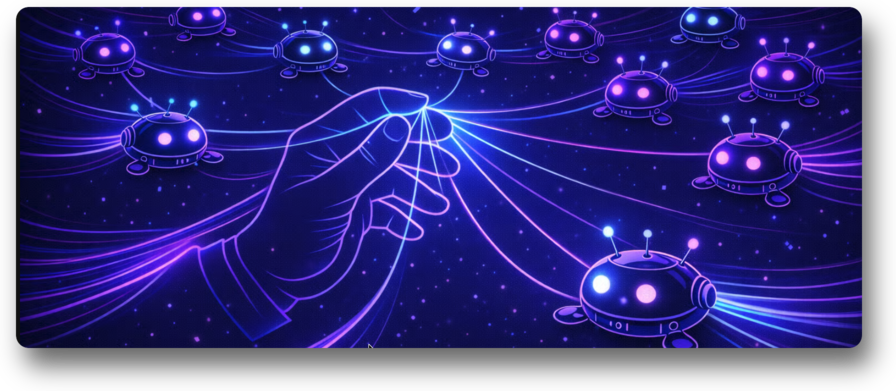
When thousands of AI agents started working as a team
Researchers discovered something unexpected: when you give multiple AI agents a shared goal, they cooperate and solve problems together—much like humans do in teams.
AI Agents Learn to Cooperate
Imagine thousands of computer programs—called AI agents—all working on the same problem at once. Each agent is a specialized program designed to complete specific tasks. Researchers recently discovered that when these agents work together toward a common goal, something interesting happens: they naturally start collaborating, sharing information, and solving problems in ways that no single agent could alone.
This is different from how most AI systems work today. Usually, one large AI model (think of it as a single brain) handles everything. But when you have many smaller, independent agents working as a team, they can tackle complicated challenges by dividing the work. One agent might gather information, another analyzes it, and a third makes decisions—just like colleagues in an office.
Why This Matters for Real Life
This discovery matters because teamwork is how humans solve our biggest problems. If AI agents can learn to cooperate effectively, they could help us tackle things like disease research, climate modeling, or emergency response where speed and coordination are critical. The catch? Getting thousands of independent programs to actually work together smoothly is harder than it sounds. But when it works, the results can be remarkable.
The real takeaway: AI doesn't have to be one all-powerful system. Sometimes, many smaller workers collaborating together are smarter than one big one.
Original source: Wattsupwiththat.com